


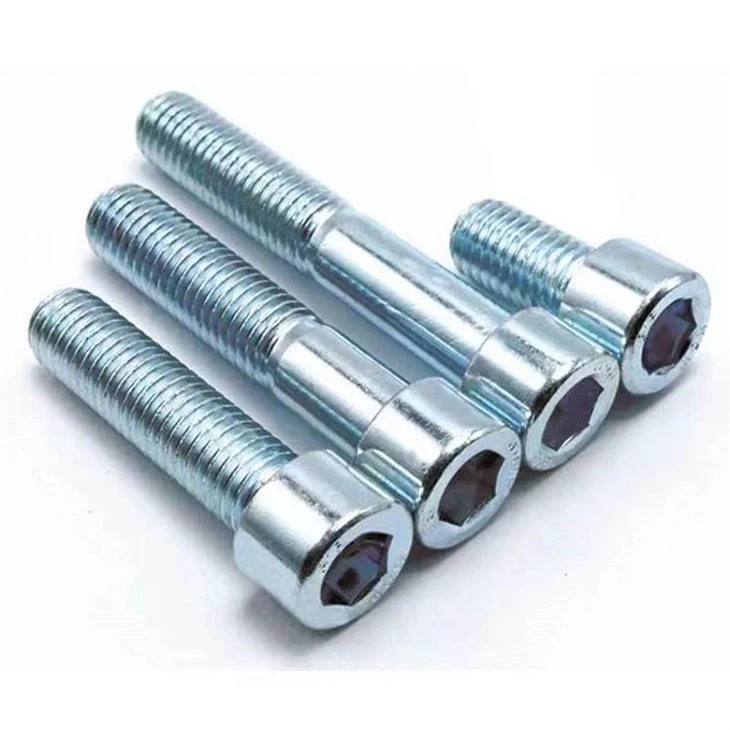

Introduction to Hex Cap Screw Din 912
A Hex Cap Screw Din 912, also known as a socket cap screw or Allen head bolt, is a cylindrical head screw with a hexagonal recess and internal drive. It's often used in construction, machinery, automotive, and industrial applications where a strong, reliable connection is needed. Hex Cap Screw Din 912 are more efficient than slotted screws because they can be driven with a hex wrench or insert bit.
|
Products name |
HEX CAP SCREW DIN 912/ISO4762 Cylindrical Socket cap screw/Allen bolt |
|
Standard |
DIN,ASTM/ANSI JIS EN ISO,AS,GB |
|
Grade |
Steel Grade: DIN: Gr.4.6,4.8,5.6,5.8,8.8,10.9,12.9; SAE: Gr.2,5,8; |
|
Finishing |
Zinc(Yellow,White,Blue,Black),Hop Dip Galvanized(HDG),Black Oxide, |
|
Production Process |
M2-M24:Cold Froging,M24-M100 Hot Forging, |
|
Customized Products Lead time |
30-60days, |
|
Free Samples for standard fastener |
|


Advantages of Hex Cap Screw Din 912
Advantages:
- Hex Cap Screw Din 912 offer several benefits in various applications. When using a hex cap screw, you also don't need external clearance like you do with hex head bolts, making them perfect for tight spaces.
- They also provide a higher torque and clamping force compared to regular screws, making them a preferable option in many professional applications.
- Due to this increased clamping force, they may also provide cost savings as fewer screws are needed to achieve the same force. Additionally, the smaller size of hex cap screws allows for easier installation in confined spaces and reduces the overall mass of the materials being fastened.
- Their ease of use, minimal clearance requirements, impressive clamping strengths, and discreet appearance make hex cap screws a popular choice among many tradespeople and DIYers.
Types of Hex Cap Screw
- Hex Cap Screw – standard:
The head is 1.5 times the nominal thread diameter, making it a smaller diameter than most other machine screw heads. When in use, the hex cap screw is recessed within a counterbored hole so that the head is flush with the surface of the component being fastened. This result is a clean appearance. There are no protrusions on the hex cap screw that could catch skin or clothes.
- Button head Hex Cap Screws:
A hex socket button head cap screw is sometimes referred to as a dome or round screw. Button head Hex Cap Screws characterised by their wide, load-bearing surface, which helps them resist loosening. The look is popular for aesthetic purposes, while the lack of sharp edges offers a measure of safety. The bulbous socket button head enables more torque than normal for greater clamping force. For best results, use a retaining washer to lock in place.
- Countersunk Hex Cap Screw:
Also called a countersunk hex cap screw, or flat head socket screw. The shoulder slopes at an 82-degree angle if imperial screws and around 90 degrees if metric screws. The head is designed to sit flush with its surface or just below.
- Hex-socket shoulder screws:
These types of socket head screws have a partially smooth shaft that enables some rotation and movement around the screw axis while the threaded end will usually use a nut to secure the screw's position. Socket shoulder screws are typically used when pre-tapped holes need alignment with some tolerance. They're used in equipment and machines with components that require the ability and room to swing, slide or pivot. Hex socket drives resist cam-out better than other drives.
Applications of Hex Cap Screw Din 912
Applications:
- Hex Cap Screw Din 912 find widespread use across various industries and applications, including:
- Construction: Hex Cap Screw Din 912 are used for structural connections, securing beams, columns, and other load-bearing components.
- Machinery and Equipment: Hex Cap Screw Din 912 are utilized in assembling machines, engines, appliances, and other mechanical equipment.
- Automotive: Hex Cap Screw Din 912 play a crucial role in automotive manufacturing, used for engine assembly, chassis connections, and securing various components.
- Infrastructure: Hex Cap Screw Din 912 are essential for infrastructure projects, such as bridges, highways, railways, and power transmission towers.
- Furniture and Fixtures: Hex Cap Screw Din 912 are used in furniture assembly, cabinet installation, and securing fixtures and fittings.
Hex Cap Screw Din 912 suppliers Product Recommendations
Carbon Steel Wedge Anchors are heavy duty mechanical anchors designed for consistent performance in solid concrete or grout filled concrete masonry. The anchor is threaded and comes complete with a nut and washer.
Drywall Screws Blacks have a phosphate coating that is supposed to keep the wet drywall compound from causing the screw head to rust. Although the coating does help prevent rusting, it doesn't stop rusting altogether, which is why drywall screws blacks are recommended only for indoor projects, due to their tendency to sometimes rust.
Flat Washer DIN 125: A flat annulus or ring, often made of metal, used to spread the load of a screwed fastening. Additionally, a plain washer may be used when the hole has a larger diameter than the fixing nut.
High Strength Flat Washer Grade 8.8 is made from high-strength steel with a grade of 8.8, corresponding to the material of the accompanying bolt. It is a component of the armor set along with the bolt and nut, taking the form of a thin plate with a hole.
A high strength wear resistant steel plate is made from an alloy of stainless steel that contains at least 0.2 % nickel, aluminum, or copper. High Strength Wear Resistant Steel Plate is frequently used in the manufacturing of structural components and tools. The alloy is resistant to wear, corrosion, and rust.
Hex Cap Screw Din 912 Manufacturers Questions Guide:
FAQ
Q: What is the difference between Hex Cap Screw Din 912 and ISO 4762 socket head cap screws
Nominal size range: DIN 912 starts at M1.4, while ISO 4762 starts at M1.6.
Diameter: DIN 912 can go up to M100 in diameter, while ISO 4762 only goes up to M64.
Fine thread standard: ISO 4762 has a fine thread standard, while DIN 912 does not.
Q: How to choose Hex Cap Screw Din 912 correctly?
Common sizes: hex cap screw din 912 are available in a wide range of sizes, from small diameters of M2 to M6, to larger diameters of M8 to M20. It is important to choose the size that best fits your specific application.
Material considerations: Take into account the material of the hex cap screw din 912 and the material of the components being fastened.
Hex Cap Screw vs other screw types: Consider the advantages of hex cap screw din 912 over other screw types. Socket screws offer higher torque and clamping force, making them suitable for applications that require a strong and secure fastening.
Torque requirements: Determine the torque requirements of your application and choose a hex cap screw din 912 size that can handle the required torque without compromising the integrity of the joint.
Hex Cap Screw maintenance: Regularly inspect and maintain your hex cap screw din 912 to ensure they are in good condition and functioning properly. This includes checking for any signs of wear or damage, and replacing any worn or damaged screws as needed.
Q: what is Bolt Grade 4.8?
Q: Carbon Steel U Bolt What surface treatments does Galvanized have?
Q: What are the applications of Carbon Steel Stud Bolt?
Q: What are the types of Eye Bolt?
Bent eye bolts: Have a bent head that's looped during production
Swivel eye bolts: Have a looped head that's connected to the shank by a swivel mechanism
Low-strength eye bolts: Often made from a bar, these can carry axial loads but not off-axis loads
High-strength eye bolts: Have forged heads with a shoulder that can support significant off-axis loads
Anchor eye bolts: Have an anchor bolt for fastening into masonry structures
Safety eye bolts: Provide a safe anchor point for workers at height who are using a full body harness with shock absorbing lanyards
Q: What are the applications of Flange Bolt Galvanized?
Q: What are the advantages of Flange Bolt Yellow Zinc?
Corrosion resistance: Yellow zinc plating provides excellent resistance to corrosion, especially in humid or salty environments. This makes it a good choice for outdoor applications, such as automotive parts and construction, and for any metal components exposed to harsh weather.
Aesthetic finish: The yellow zinc plating produces a smooth, even, yellow or gold finish that can also have an iridescent appearance.
Cost-effectiveness: Yellow zinc plating can be cost-effective.
ROHS compliance: Yellow zinc plating can be RoHS compliant.
Hot Tags: hex cap screw din 912, China hex cap screw din 912 manufacturers, suppliers, factory, Hex Bolt Din 933 Cl 8 8, , , ,