

Do Din557 square nuts have a standard tolerance?
As a supplier of Din557 square nuts, I often encounter inquiries from customers about the standard tolerance of these nuts. In this blog post, I will delve into the topic to provide a comprehensive understanding of whether Din557 square nuts have a standard tolerance.
Understanding Din557 Square Nuts
Din557 square nuts are a type of fastener that conform to the German Institute for Standardization (DIN) standard 557. These nuts are characterized by their square shape, which provides a larger surface area for contact compared to hexagonal nuts. This feature makes them suitable for applications where a high level of torque is required or where the nut needs to be tightened against a flat surface.

The Concept of Tolerance in Fasteners
Tolerance in the context of fasteners refers to the allowable variation in the dimensions of a nut or bolt. It is crucial because it ensures that the fasteners can be used interchangeably and that they will fit properly with the corresponding bolts or threaded rods. Tolerance is typically expressed in terms of plus or minus values from the nominal dimension.
Standard Tolerance for Din557 Square Nuts
Yes, Din557 square nuts do have a standard tolerance. The DIN standards specify the dimensional requirements, including tolerances, for various types of fasteners, including square nuts. These standards are designed to ensure the quality, compatibility, and interchangeability of fasteners across different manufacturers and applications.
The tolerance for Din557 square nuts covers several key dimensions, such as the width across the flats, the height of the nut, and the thread diameter. For example, the width across the flats of the nut has a specified tolerance range. This ensures that the nut will fit correctly into the intended space and that the tools used for tightening or loosening the nut will work properly.
Similarly, the height of the nut also has a defined tolerance. This is important because the height affects the overall length of the threaded connection and the amount of engagement between the nut and the bolt. If the height tolerance is not met, it can lead to issues such as insufficient thread engagement, which can compromise the strength and reliability of the connection.
The thread diameter tolerance is another critical aspect. It ensures that the nut will thread onto the bolt smoothly and that the connection will have the appropriate level of tightness. If the thread diameter is too large or too small, it can result in a loose or tight fit, respectively, which can affect the performance of the fastener.
Importance of Standard Tolerance
The standard tolerance for Din557 square nuts serves several important purposes. Firstly, it guarantees the compatibility of the nuts with the corresponding bolts. When a customer purchases a Din557 square nut, they can be confident that it will fit a bolt that meets the same DIN standard. This eliminates the need for custom fitting or modification, which can save time and cost in manufacturing and assembly processes.
Secondly, standard tolerance ensures the quality and reliability of the fasteners. By adhering to the specified tolerance range, manufacturers can produce nuts that have consistent dimensions and performance. This reduces the risk of failure due to improper fit or weak connections, which is especially important in applications where safety is a concern, such as in automotive, aerospace, and construction industries.
Thirdly, standard tolerance promotes interchangeability. In a manufacturing environment, it is common to have multiple suppliers of fasteners. With a standard tolerance, parts from different suppliers can be used interchangeably without any issues, which provides flexibility and reduces the risk of supply chain disruptions.
How Our Company Ensures Standard Tolerance
As a supplier of Din557 square nuts, we are committed to meeting the standard tolerance specified by the DIN 557 standard. We have a strict quality control process in place to ensure that every nut we produce meets the required dimensions.
Our manufacturing process starts with the selection of high - quality raw materials. We source our steel from reputable suppliers to ensure the strength and durability of our nuts. During the manufacturing process, we use advanced machinery and tools that are calibrated regularly to maintain the accuracy of the dimensions.
After the nuts are manufactured, they undergo a series of quality inspections. Our quality control team uses precision measuring instruments, such as calipers, micrometers, and thread gauges, to check the dimensions of the nuts against the DIN 557 standard. Only nuts that meet the specified tolerance range are approved for shipment.
Related Products
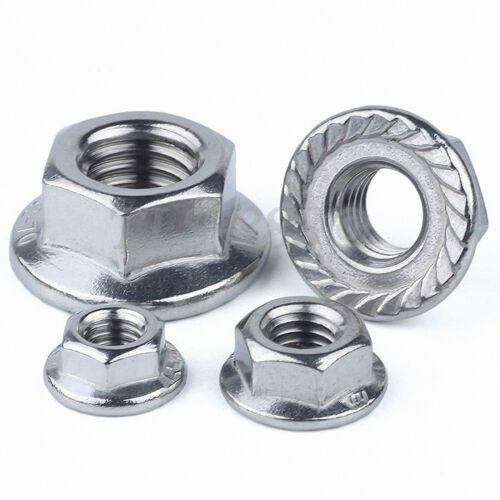
In addition to Din557 square nuts, we also offer a wide range of other fasteners, including Flange Nut Din 6923, Hex Coupling Nut Din 6334, and Nylon Lock Nut Din 985 Din 982. These products also adhere to the relevant DIN standards and have their own standard tolerances.
Contact for Procurement
If you are in the market for high - quality Din557 square nuts or any of our other fastener products, we invite you to contact us for procurement discussions. We are dedicated to providing excellent customer service and competitive pricing. Our team of experts can help you select the right fasteners for your specific applications and answer any questions you may have about standard tolerances or other technical aspects.
References
- DIN 557 Standard for square nuts
- Engineering handbooks on fastener technology
- Industry research on the importance of standard tolerances in fasteners