

Ductility is a fundamental mechanical property that plays a crucial role in the performance and suitability of various engineering materials, including fasteners like the Hex Bolt Din 931. As a supplier of Hex Bolt Din 931, understanding the ductility of these bolts is essential for ensuring that they meet the diverse needs of our customers across different industries.
Understanding Ductility
Ductility refers to the ability of a material to deform plastically under tensile stress without fracturing. In simpler terms, it is the measure of how much a material can be stretched or drawn into a wire or elongated before it breaks. This property is particularly important in applications where the material may be subjected to significant forces or where it needs to conform to specific shapes during installation or use.
The ductility of a material is typically expressed as a percentage of its original length or cross - sectional area after it has been stretched to the point of fracture. For example, if a bolt has an original length of 100 mm and it can be stretched to 120 mm before breaking, its ductility is 20%. This value can vary widely depending on the material composition, manufacturing process, and heat treatment of the bolt.
Ductility of Hex Bolt Din 931
Hex Bolt Din 931 is a widely used fastener in the engineering and construction industries. These bolts are made from a variety of materials, with carbon steel being one of the most common. The ductility of a Hex Bolt Din 931 made from carbon steel depends on several factors:

Material Composition
The carbon content in the steel has a significant impact on its ductility. Generally, as the carbon content increases, the strength of the steel increases, but its ductility decreases. Low - carbon steels, typically with a carbon content of less than 0.3%, tend to have higher ductility compared to high - carbon steels. This is because carbon atoms can form hard and brittle carbide phases in the steel, which restrict the movement of dislocations and make the material more prone to fracture.
Manufacturing Process
The manufacturing process of Hex Bolt Din 931 also affects its ductility. Cold - heading is a common method used to produce these bolts. During cold - heading, the steel is deformed at room temperature, which can introduce internal stresses and work - harden the material. While work - hardening can increase the strength of the bolt, it can also reduce its ductility. Heat treatment processes, such as annealing, can be used to relieve these internal stresses and restore some of the ductility of the bolt.
Heat Treatment
Heat treatment is a crucial step in the production of Hex Bolt Din 931. Normalizing, quenching, and tempering are common heat - treatment processes. Normalizing involves heating the bolt to a specific temperature and then allowing it to cool in air. This process refines the grain structure of the steel, improving its mechanical properties, including ductility. Quenching, on the other hand, involves rapid cooling of the heated bolt, which can increase its hardness but reduce its ductility. Tempering is then used after quenching to relieve the internal stresses and improve the ductility of the bolt.
Importance of Ductility in Hex Bolt Din 931
The ductility of Hex Bolt Din 931 is important for several reasons:
Safety
In structural applications, bolts are often subjected to dynamic loads, such as vibrations or impact forces. A bolt with good ductility can deform plastically under these loads, absorbing energy and preventing sudden and catastrophic failure. This is particularly important in critical structures, such as bridges and buildings, where the failure of a single bolt can have serious consequences.
Installation
During installation, Hex Bolt Din 931 may need to be tightened to a specific torque. If the bolt has low ductility, it may be more likely to break or crack during tightening. A ductile bolt, on the other hand, can deform slightly without fracturing, allowing it to be tightened properly and ensuring a secure connection.
Compatibility with Other Materials
In many applications, Hex Bolt Din 931 is used in conjunction with other materials, such as nuts and washers. A bolt with appropriate ductility can better accommodate the different expansion and contraction rates of these materials due to temperature changes, reducing the risk of loosening or failure over time.
Related Products
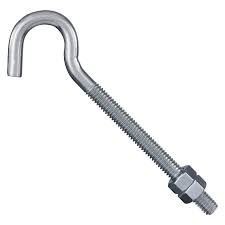
As a supplier of Hex Bolt Din 931, we also offer a range of related products that may be of interest to our customers. Hook Bolt Zinc Plated is a type of bolt with a hook - shaped end, which is commonly used in applications where a secure connection is required, such as in suspension systems. Hex Bolt Din 933 Full Thread is similar to the Hex Bolt Din 931 but has a full - threaded shank, making it suitable for applications where a longer threaded section is needed. Flange Bolt Din 6921 Cl 8.8 is a high - strength bolt with a flange that acts as an integrated washer, providing a larger bearing surface and better resistance to loosening.
Contact for Purchase and Negotiation
If you are interested in purchasing Hex Bolt Din 931 or any of our other products, we encourage you to contact us for further discussion. Our team of experts is ready to assist you in selecting the right fasteners for your specific application and to negotiate the best possible terms. Whether you need a small quantity for a DIY project or a large order for an industrial application, we can meet your requirements.
References
- Callister, W. D., & Rethwisch, D. G. (2016). Materials Science and Engineering: An Introduction. Wiley.
- Shigley, J. E., Mischke, C. R., & Budynas, R. G. (2004). Mechanical Engineering Design. McGraw - Hill.
- Machinery's Handbook: A Reference Book for the Mechanical Engineer, Designer, Manufacturing Engineer, Draftsman, Toolmaker, and Machinist. Industrial Press.