


Hebei Mitu Trading Co.,Ltd. was established in 1998, is a large and professional manufacture of high-strength fasteners, and is located in Yongnian County, Handan City, Hebei Province, China. Main product standards: German standard (DIN), American standard (ANSI/ASTM), British standard (BS), China national standard (GB), and other international standards. Product mechanical performance levels cover 4.8, 8.8, 10.9, 12.9, etc.
Why Choose Us
High Quality
Our products are manufactured or executed to very high standards, using the finest materials and manufacturing processes.
Factory
In line with the tenet of "quality first, credibility first, service first", we always develop with the goal of "creating the best supplier".
24h Online Service
Our terms of work have always been fixed within the work process and one can be assured about the guarantee of the work as we are there 24/7 business hours during the time your project is being worked is on.
Rich Experience
Our company has many years of production work experience. The concept of customer-oriented and win-win cooperation makes the company more mature and stronger.

Flange bolt Din 6921 Cl 8.8, The flange bolt is composed of hexagon head and flange plate (the gasket under the hexagon and the hexagon is fixed together) and the screw (cylinder with external thread). It needs to be matched with the nut to fasten the parts connecting the two through holes.

DIN 6921 is a German standard for hexagon flange bolts. The CL 8.8 designation refers to the material and strength grade of the bolt. 8.8 means the bolt material has a tensile strength of at least 800 N/mm² and a yield strength of 640 N/mm².

Flange bolt yellow zinc are bolts whose surface has been passivated by yellow zinc and consists of a hexagonal head, a flange surface and a screw rod. The difference yellow zinc and ordinary galvanizing is that yellow zinc plating refers to passivation treatment after electroplating (it is basically the same as color zinc plating except for the color). The purpose of this is to further improve the screws corrosion resistance.

Metric flange bolt Din 6921 are machine threaded bolts that have a circular washer like flange under the head that increases the bearing surface to distribute the load when the bolt is fastened to the substrate. Flange bolt Din 6921 are available with and without serrations.
Property Class 10.9 bolts and screws have a minimum tensile strength of 1040 MPa for all sizes. As you can see, they're slightly stronger than the nominal value in the property class designation. Property Class 10.9 bolts are considered high-strength parts.

The grade 4.8 bolt is a standard specification of low or medium carbon alloy grade. Grade 4.8 Bolts can be either fully or partially threaded. These bolts have an external male thread that has a matching female thread.

Bolt class 8.8 represent the tensile (tensile) strength of the bolt. This means how much force can be applied to the bolt before it breaks under that force. It is the most common high-strength material and is usually stocked in gloss or zinc.

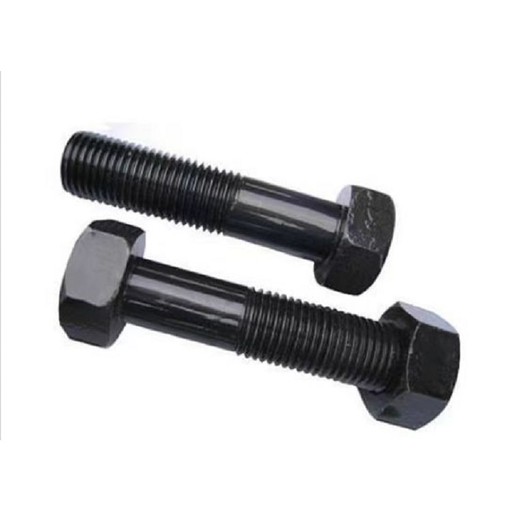
Hex bolts plain are a type of threaded bolt, characterised by their six-sided hexagonal-shaped head. Hex bolts can be either fully threaded or partially threaded (featuring a clear shank along part of the body) and are suitable for use in a wide range of applications, typically machinery and construction.

Hex bolt black are machine bolts that have been designed to adhere facing materials to prevent shear movement. Specifically in wood to wood, wood to metal or metal to metal applications. These bolts are coated in a black ceramic finish to match the latest trends in DIY hardware.
Hex bolt black are machine bolts that have been designed to adhere facing materials to prevent shear movement. Specifically in wood to wood, wood to metal or metal to metal applications. These bolts are coated in a black ceramic finish to match the latest trends in DIY hardware. You can use a wrench or socket to tighten or loosen them. Hex bolt black come in different sizes and materials, so they can be used in many different situations.
Advantages of Hex Bolt Black
Six-sided head design
The hexagonal-shaped head is the most distinctive feature of a hex bolt black, hence its name. This design allows for a secure grip with a wrench or a socket, and provides a broad surface area for tools to apply torque.
Versatility
They are ideal for heavy-duty fixing and fastening applications, and their uses span from construction projects to machinery assemblies, woodworking tasks, engineering applications, and vehicle or automotive repairs.
Tensile properties
Hex bolt black offer strong tensile properties. They are designed to bear heavy loads, which makes them ideal for applications that demand strength, such as the construction of buildings, bridges, and road infrastructures.
Strength
Hex bolt black are designed to provide a strong and reliable fastening solution. They can withstand high loads and stresses without deforming or breaking. Hex bolt blacks are often made from high-strength materials such as steel or titanium, which makes them highly durable and resistant to corrosion, wear, and other forms of damage.
How is the Black Coating Applied to Hex Bolts?
Black oxide thermal finishes are considered a conversion coating, which replicates the surface finish of the part. Before the thermal black oxide finish is applied, a top layer of oil is applied to enhance corrosion resistance. The black oxide is then applied through either a hot or cold process. The thermal black oxide hot process utilizes different types of chemicals to convert the surface materials into magnetite. The black oxide coating bolts and nuts are dipped into different chemicals, followed by water. An extra layer of oil is then applied to provide further corrosion-resistant properties.
The head of the bolt is generally hexagonal, and the insertion tool is a fork wrench or wrench. The "thread" refers to the belly part of the screw, which is generally half a circle. It has a compact structure and can be used with various nuts at high torque without fear of lateral force. The hex bolt black is hexagonal, the insertion tool is a hexagonal wrench, and there are hexagonal protrusions on the bolt rod that can be rotated with a wrench or hexagonal wrench. They are usually used with hex nuts.
Can Black Hex Bolts be Welded?
Not all bolt materials are suitable for welding. For example, high-carbon steel bolts are difficult to weld due to their high carbon content and high melting point, and are prone to cracks after welding, affecting their strength and reliability. Therefore, if high carbon steel bolts need to be welded, they need to be preheated to avoid cracks. For bolts made of ordinary mild steel, welding can be performed, but only if the welding process is properly handled. Bolts should be treated before welding, such as removing patina, grease, and other surface contaminants, and using sandpaper to clean the surface. Also, attention should be paid to the diameter and length of the bolt to prevent excessive heat from deforming or melting the bolt.
How to Choose The Right Hex Bolt Black
Determine the load-bearing capacity required for the connection. Understand the environmental conditions the bolt will be exposed to (corrosive, outdoor, indoor, etc.). Consider any specific regulations or standards that apply to your project.
Choose a material suitable for the project's environment (e.g., stainless steel for corrosion resistance, high-strength alloy steel for heavy loads). Consider factors such as temperature, humidity, and potential exposure to chemicals.
Select an appropriate bolt grade based on the required strength. Bolt grades are often indicated by markings on the head of the bolt. Common grades include ASTM A307, ASTM A325, ASTM A490 for structural applications.
Determine the required thread size (diameter) and pitch (distance between threads). Match the thread size with the corresponding nut size and the tapped hole size, if applicable.
Choose a bolt length that provides enough thread engagement while ensuring that the bolt doesn't extend excessively beyond the nut or threaded hole. Select a head style that suits your project's needs. Common head styles include hexagonal, flange, or socket head.
Material of Hex Bolt Black
Hex Bolts are made of 8.8 grade alloy steel, and the surface has been blackened. It is more rust-resistant and corrosion-resistant, durable and not easy to break, which prolongs the service life of the product.
How to Install Hex Bolt Black
Confirm the installation location and bolt specifications
Before installing hex bolt black, you first need to confirm the installation location and bolt specifications. After confirming the installation location, you need to confirm the bolt specifications in order to select the appropriate wrench or torque wrench and other tools.
Clean the mounting holes and threads
Cleaning the mounting holes and threads will ensure the tightness of the installed hex bolt black. If there are debris or rust in the mounting holes or threads, you can use a brush or other cleaning tools to clean them. After cleaning, the mounting holes and threads need to be wiped clean.
Insert the bolts
Insert the correct size hex bolt black into the cleaned threads. It should be noted that the direction of inserting the screw should be opposite to that of the nut or washer. To insert bolts, you need to use tools such as a wrench or torque wrench. You need to select the appropriate tool according to the actual situation.
Rotate and tighten the bolts
Turn the bolt until it is fully inserted into the mounting hole, using a steady rotation wrench or torque wrench while doing so. After the rotation is completed, you need to use a wrench or torque wrench to tighten the nut or washer to the specified torque. It should be noted that the order and direction of the nuts or washers should be correct to avoid problems such as loosening or twisting of the bolts.
What is the Purpose of Using a Hex Bolt Black?
Hex bolt black are used to securely fasten two or more objects together. The threading on the shaft allows them to create a tight and strong connection between the components being joined. Hex bolt black are often used in structural applications where the integrity of the connection is crucial. The secure fastening provided by hex bolt black makes them effective in applications where components are subjected to vibrations or dynamic loads. They are less likely to loosen over time compared to other types of fasteners. The six-sided head of the hex bolt black ensures a more uniform distribution of torque when tightening, which can reduce the risk of over-tightening or uneven pressure on the components being fastened.
Process of Hex Bolt Black
Material Selection
The process begins with selecting the appropriate material for the hex bolts. Common materials include carbon steel, stainless steel, and alloy steel. The choice of material depends on factors such as strength requirements, corrosion resistance, and the intended application.
Wire Drawing
The selected material is typically in the form of wire. The wire is drawn through a series of dies to reduce its diameter and improve its mechanical properties. This process also helps to ensure a consistent and uniform material for further processing.
Cutting
The drawn wire is then cut into individual lengths, each of which will become a single hex bolt. The length of the wire determines the overall length of the bolt.
Heading
The cut wire lengths are then heated and placed into a heading machine. The heading machine applies pressure to one end of the wire to create the hexagonal head shape. This process also forms the initial shape of the unthreaded shank.
Thread Rolling
The threaded portion of the hex bolt is created through a process called thread rolling. The unthreaded shank is passed through a set of dies that press and deform the material, forming the threads. Thread rolling produces strong and precise threads.
Chamfering and Pointing
The tip of the hex bolt is chamfered or pointed to aid in insertion and alignment during installation. This is typically done through machining or grinding.
Heat Treatment
To improve the mechanical properties of the hex bolt, it undergoes a heat treatment process. This process involves heating the bolt to a specific temperature and then rapidly cooling it (quenching) to achieve the desired hardness and strength.
Surface Treatment
Hex bolts may undergo surface treatments to enhance their corrosion resistance and appearance. Common surface treatments include zinc plating, galvanization, or applying coatings like black oxide.
Application of Hex Bolt Black
Marine
Hex bolt black are commonly used in marine applications, such as boat building and repair, where they provide strong and durable fastening for components exposed to saltwater and other harsh environmental conditions.
Heavy-duty Machinery Manufacturing
In the process of manufacturing heavy-duty machinery and equipment, hex bolt black that can withstand heavy loads and vibrations are often required. These bolts are very strong and can ensure a strong and stable connection in harsh working environments.
Automobile Manufacturing
In the manufacturing and maintenance of automobiles, a large number of hex bolt black are used. These bolts are widely used to secure different parts, support the vehicle body, and transmit power. It has the characteristics of high strength and corrosion resistance, and can meet the high performance and high-speed operation requirements of automobiles.
Construction Engineering
Hex bolt black can be used in various connection and fixation processes of building structures. These bolts can be used to connect and fix large steel structures, support floor slabs, fix cable trays, etc.
Things to Note When Using Hex Bolt Black
When installing hex bolt black, pay attention to the position and direction of the bolts to ensure that the bolts and nuts can be combined correctly and that the tightening force of the nuts is even and appropriate. Over-tightening hex bolt black will cause the bolts to be overstretched or broken, which will not only affect their tightening effect, but also affect the safety of the machine and equipment, so appropriate tightening strength must be mastered. During the use of machinery and equipment, hex bolt black are often affected by heavy loads and vibrations, and are prone to nut loosening and bolt breakage. Therefore, bolts need to be checked and replaced regularly to ensure the normal operation of the machine and equipment.
How to Maintain Hex Bolt Black
Hex bolt black should be stored in a dry place to avoid moisture and corrosion. Storage in a humid environment will cause corrosion on the surface of the bolts, and in severe cases, damage to the threads. The operation of machinery and equipment will be accompanied by the accumulation of dirt and dust. If not cleaned in time, they will affect the tightness of the threads and make the hexagonal bolts The tightening effect is reduced. During the bolt torsion process, an appropriate amount of lubricating oil or grease can be added. Lubricants can reduce friction between bolts and base metal, extending service life.
Certifications


FAQ
Q: What is the difference between hex bolt black and silver bolts?
Q: Why are some hex bolt black?
Q: What is the difference between a hex bolt black and a normal bolt?
Q: What is the hardest grade bolt you can buy?
Q: What is the most rust-resistant hex bolt?
Q: Are hex bolt black stronger?
Q: Why are high tensile bolts black?
Q: What metal are hex bolt black?
Q: Where are hex bolt black used?
Q: Why are 12.9 bolts black?
Q: What is the difference between a hex screw and a hex bolt black?
Q: Do hex bolt black rust?
Q: What are black bolts coated with?
Q: Is zinc plated bolts better than black oxide?
Q: Why are automotive bolts black?
Q: Why use black oxide bolts?
Q: Do aluminum bolts exist?
Q: What metal are car bolts made of?
Q: What are the advantages of hex bolt black?
Q: Do hex bolt black have a shelf life?
Hot Tags: hex bolt black, China hex bolt black manufacturers, suppliers, factory, Hex Bolt Din 933 Cl 8 8, , , ,